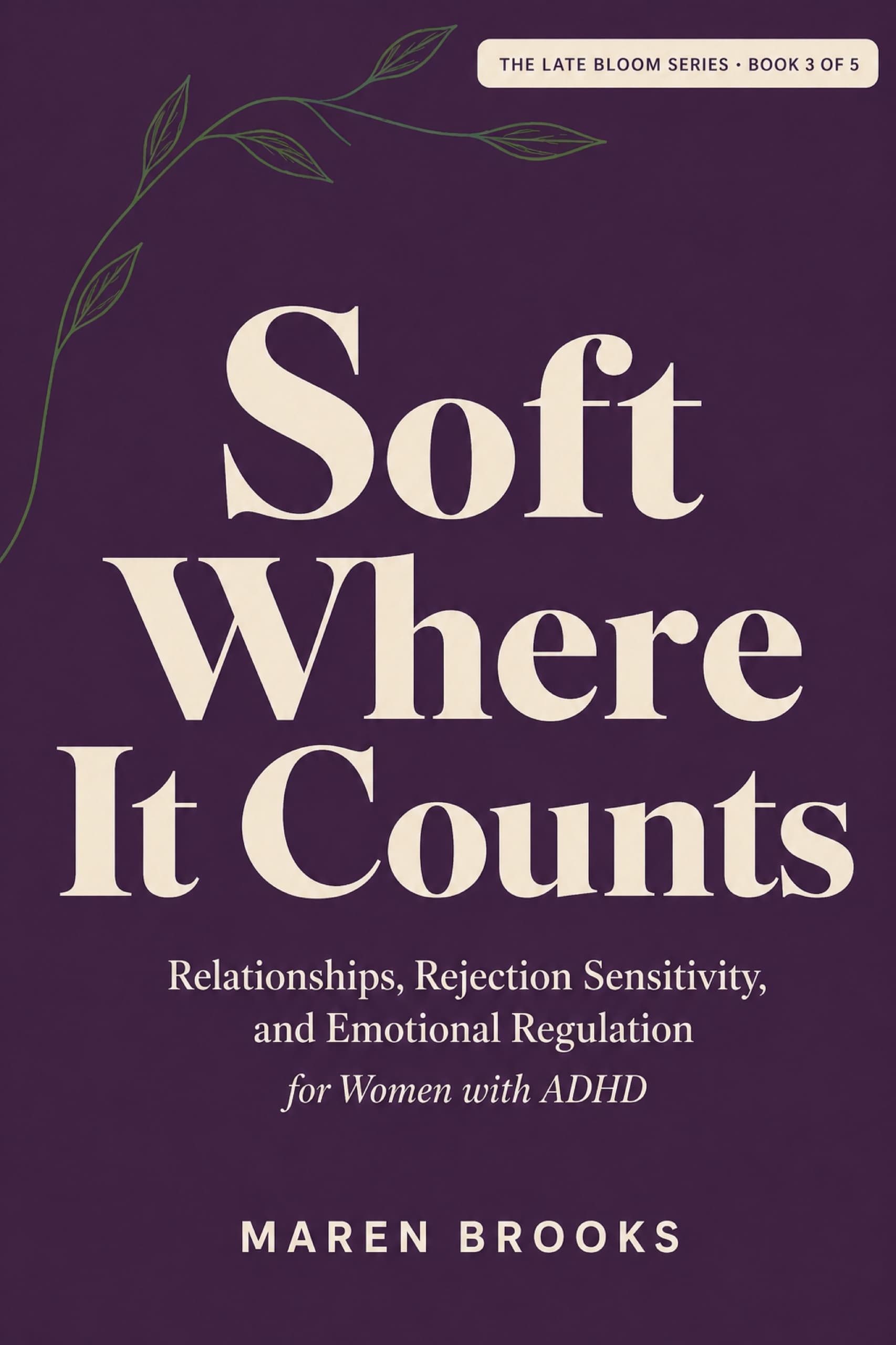
About this book
What you’ll find inside.
It is 11:14 on a Tuesday night and you are standing in your kitchen, replaying a sentence your husband said two hours ago in a tone you cannot now reproduce but cannot stop hearing.
You don't know if he meant what you heard. You don't know if you'll sleep. You know that whatever happens tomorrow, you'll apologize first, because you always do, and you'll feel both relieved and slightly demolished by it.
None of this is a character flaw. It has a name and a mechanism, and there are three moves that work.
For women diagnosed with ADHD late in life, relationships that hold are not built by reading another couples-therapy book. They are built by understanding the specific neurobiological pattern — rejection sensitive dysphoria — that has been hijacking your closest connections for thirty years, and by learning the small set of moves that interrupt it before it costs you another forty-eight hours.
Maren Brooks is an ADHD coach who got her own diagnosis at thirty-six, after her daughter's. She has coached more than four hundred women through the first two years post-diagnosis. Soft Where It Counts is the third book in her Late Bloom Series, written for the woman whose habits are partly in place, whose focus practice is starting to hold, and who is now noticing that the same patterns that broke focus and habits also break marriages, friendships, and family.
This is not a couples-therapy workbook. It is not a step-by-step program. It is a field guide. Letters from inside a marriage that has worked through the same patterns, with practical tools tucked into the chapters where they fit.
Inside, you will discover:
- What rejection sensitive dysphoria (RSD) actually is — the felt experience, the neurobiological mechanism, and why it is not in the standard couples-therapy literature
- The shape of the 48-hour RSD cascade — trigger, rumination, withdrawal-or-attack, replay — so you can recognize it while you are in it
- Three in-the-moment moves that interrupt the cascade: body-first reset, the 90-second rule, and the 30-minute delay (with the literal three-line script)
- Why couples-therapy frameworks like Sue Johnson's EFT and the Gottman method miss the ADHD reader's two-meltdown problem — and the bridge move that makes them work
- The Relational Floor — the minimum-viable presence threshold below which you pause rather than perform
- The three-sentence repair protocol that doesn't grovel: describe, acknowledge, commit, then stop talking
- Why the long-marriage retroactive grief after a mid-life diagnosis is real, has a four-to-eight-month time course, and does not have to become the rest of your life
- The fifteen-minute weekly debrief that has produced more improvement in marital satisfaction than any single practice in Maren's coaching
- Why you keep cancelling on your closest friends, the soft-disclosure script that lets the friendship hold, and the re-entry script for friends you've drifted from
- The Lindsay Gibson layer plus the ADHD layer for family-of-origin work, including the pre-and-post Thanksgiving protocol most late-diagnosed women have never been taught
If you have ever cried in a bathroom after a feedback email, gone silent for three days because someone's tone felt off, started a fight with the person you love most because they cancelled dinner, or quietly wondered whether you might be too much for the people who love you — this is the relationship book you have been looking for.
You are not too much. You are wired differently. We can work with that.
Book 3 of The Late Bloom Series — habits, focus, relationships, career, and motherhood for women with ADHD diagnosed late. Soft Where It Counts is available on Kindle and free with Kindle Unlimited.