About this book
What you’ll find inside.
You bought Deep Work. You read the first two chapters in one sitting, hyperfocused. By the end of week two you couldn't remember where you'd put the book.
You set up the Pomodoro timer. You downloaded Forest. You tried the four-hour writing block. You followed Cal Newport's rules for nine days. On the tenth, you fell into a Wikipedia rabbit hole and lost a Tuesday afternoon.
This was not a discipline problem.
For women diagnosed with ADHD late in life, focus that actually holds is not built by reading another productivity book. It is built by understanding the specific reasons "deep work" advice silently fails the ADHD brain — dopamine dysregulation, fragile working memory, time blindness, hyperfocus crashes — and designing a focus practice for the brain you have.
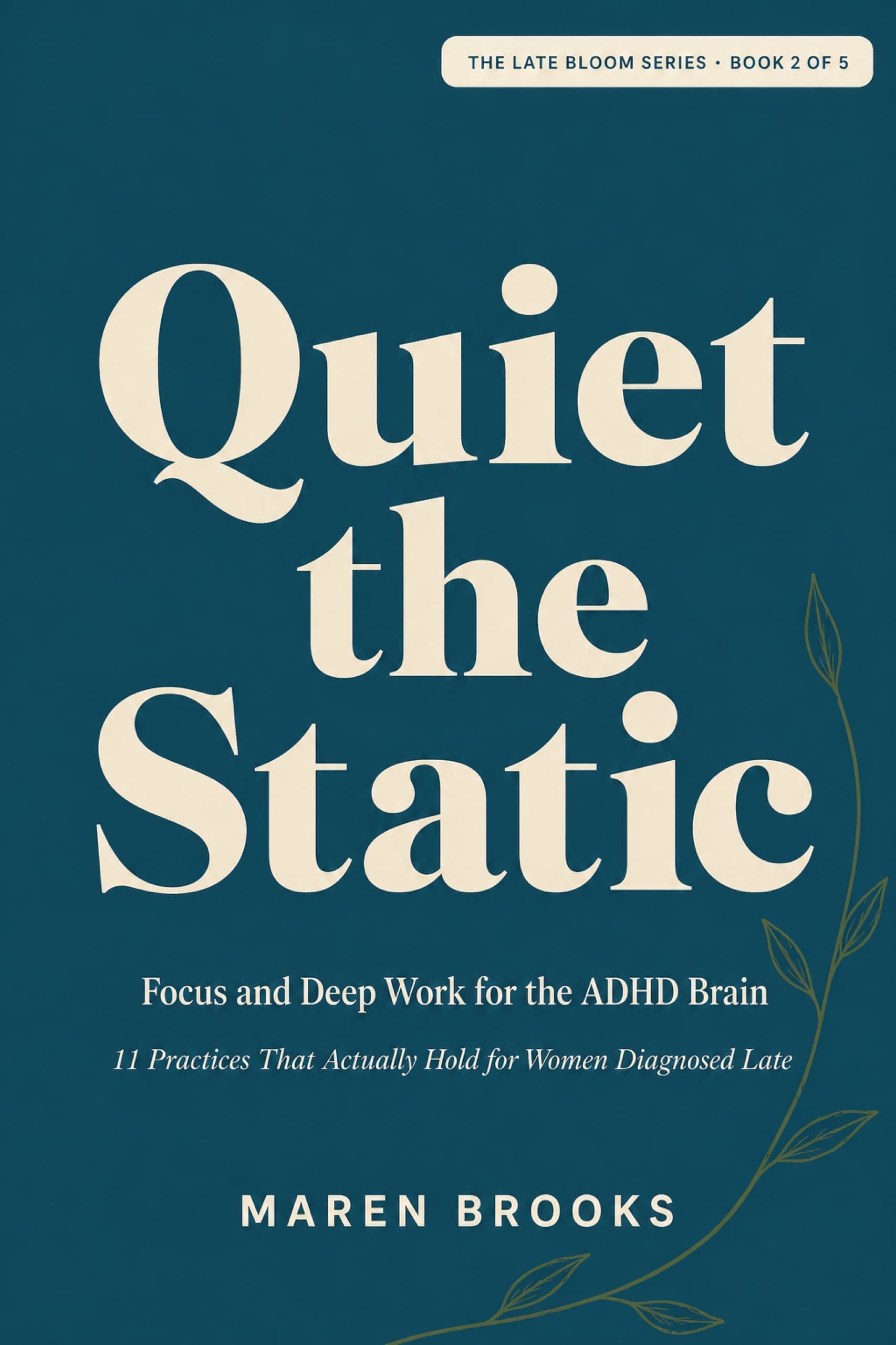
Maren Brooks is an ADHD coach who got her own diagnosis at thirty-six, after her daughter's. She has coached more than four hundred women through the first two years post-diagnosis. Quiet the Static is the second book in her Late Bloom Series, written for the reader who has habits in place and is now hitting the wall labeled I still cannot focus on what I don't want to focus on.
This is not a workbook. It is not a lecture. It is a field guide. Letters from one late-diagnosed woman to another, with practical tools tucked into the chapters where they fit.
Inside, you will discover:
- The specific assumption each canonical focus book — Newport's Deep Work, Bailey's Hyperfocus, Clear's Atomic Habits, the Pomodoro technique — silently makes that ADHD biology breaks
- Why the 25-minute Pomodoro timer fires at the worst possible moment in the ADHD attention curve — and what works instead
- The Focus Floor — the minimum-viable attention threshold below which you reset rather than push through, and the five-day audit to find your own
- The 90-Minute Frame — what deep work actually looks like when you redesign it for an ADHD brain, with a clean entry, a planned crash point, and a deliberate exit
- Three practices for surviving meeting-heavy weeks, including the protected micro-block and the five-minute meeting-recovery practice
- Two practices for reading without rereading, so books stop dissolving on contact
- Three practices for finishing what you start, including the 80% ship rule and the witnessed-finish protocol
- Three practices for using hyperfocus deliberately rather than letting a six-hour Wikipedia rabbit hole steal your Tuesday
- The hyperfocus container that converts your most expensive attentional state into your highest-leverage tool
- Why "hyperfocus is your superpower" is half right and dangerous without containment — and how to install the containment
- The sustainable rhythm for ADHD deep work: two frames a day, four to five days a week, with real repair windows in between
- How the four daily anchors from You're Not Lazy extend into a full focus practice, so book one and book two compound rather than compete
"I read three productivity books in the year after my diagnosis. None of them addressed why my focus actually breaks. This is the one that did." — what her clients keep telling her.
If you have tried the planners, the focus apps, the standing desk, the noise-canceling headphones, and the four-hour block that produced four-hour graveyards — and you are tired of systems that were never designed for your brain — this is the focus book you have been looking for.
Your focus isn't broken. It was never broken. Now you have the practice that fits the brain you actually have.
Book 2 of The Late Bloom Series — habits, focus, relationships, career, and motherhood for women with ADHD diagnosed late. Quiet the Static is available on Kindle and free with Kindle Unlimited.