About this book
What you’ll find inside.
The day my daughter was diagnosed, my therapist looked at me and said, "I think we need to talk about you, too." We were both late.
If you are holding this book, you may have lived through some version of that afternoon. The pediatrician's call. The school evaluation. The neuropsychologist's report. The moment your child's intake form read like a list of things you have been criticized for since you were her age.
You are part of a rapidly growing demographic — the late-diagnosed mother whose ADHD diagnosis arrived after one of her children's. Adult women's ADHD diagnoses rose by 344 percent between 2007 and 2016, and the parallel-diagnosis pathway is the fastest-growing segment within that. There is a name for this now. There is a way through.
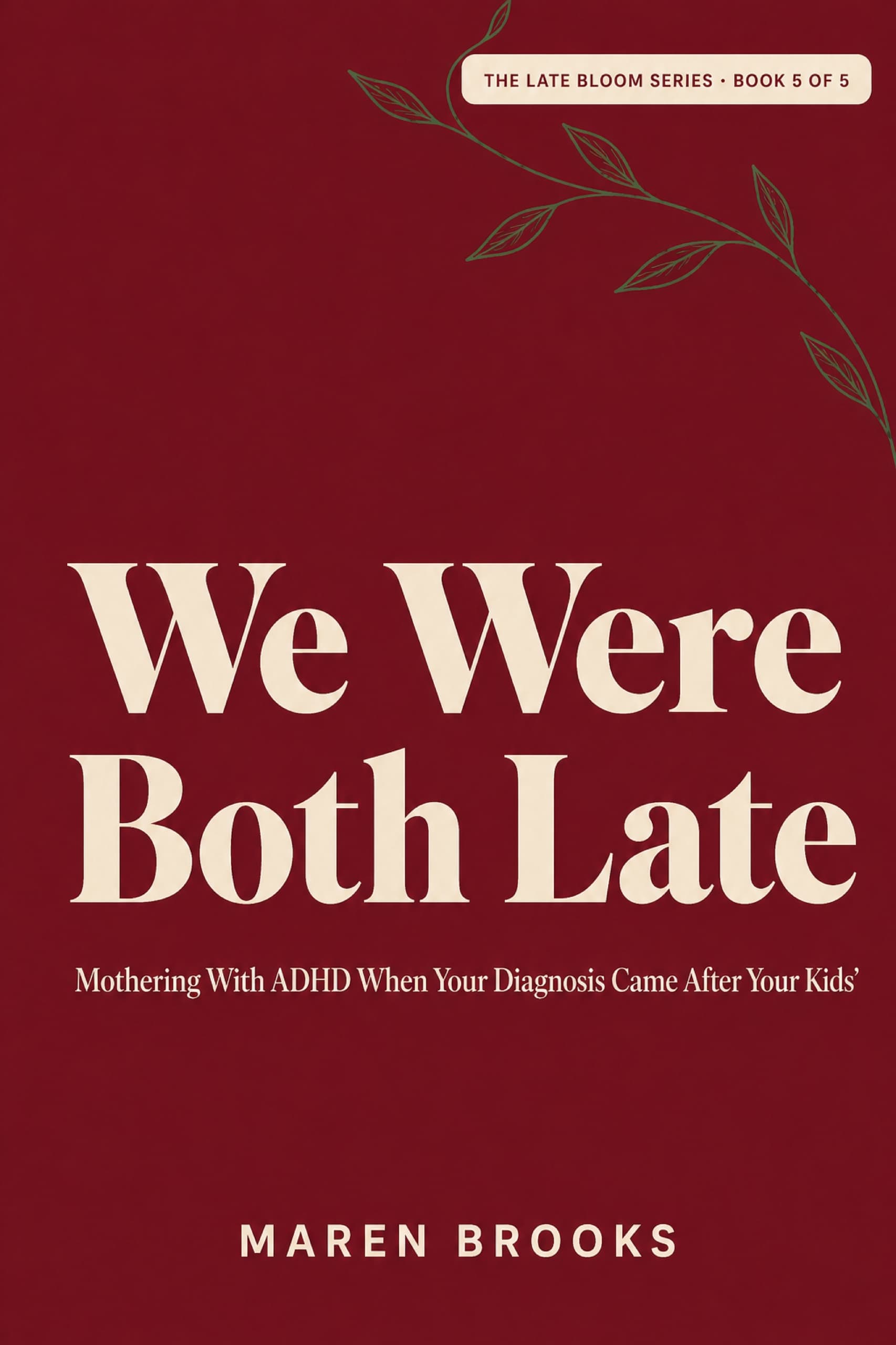
Maren Brooks is an ADHD coach who got her own diagnosis at thirty-six, three months after her daughter's. We Were Both Late is the fifth and final book in her Late Bloom Series — the capstone, written for the woman whose habits, focus, relational toolkit, and workplace practice are now ready to land in the family system, where every framework matters most.
This is not a parenting manual. It is a field guide written from inside the family system — by a mother who got her diagnosis the same year her daughter did, who has spent the three years since coaching other late-diagnosed mothers in the same spot.
Inside, you will discover:
- The Co-Regulation Loop — what to do when your child is dysregulated and you are too. Three stabilizer moves, ninety seconds, with developmental variants for the 5- to 8-year-old, the 9- to 12-year-old, and the teen. The framework that does NOT require you to be calm first.
- The Family Day Architecture — four anchored windows (morning school launch, midday recovery, afternoon pickup transition, evening bedtime co-regulation) that make the moments where you most need the Co-Regulation Loop predictable, sequenced, and supported by the day's shape.
- The maternal floor — the minimum-viable presence you can sustain when depleted. Sibling of the focus floor and the relational floor.
- The Three-Sentence Repair adapted for the apology you owe your child, in three developmental variants. The shorter apology lands. The longer one asks the child to manage your distress.
- The maternal RSD framework — what to do with the school email that triggers a 48-hour spiral, the playdate that ended early, the friend group your child was left out of. Wait the window. Respond from a regulated state.
- The bad-day recovery protocol — the operational difference between a hard day (which doesn't require repair) and a rupture day (which does). The 1 hour / 1 day / 1 week recovery shape, adapted for the parental context.
- The Generational Pattern Ledger — the multigenerational inheritance question. Was your own mother ADHD too? (Statistically, often yes.) One specific keep, one specific break, one specific new thing. You are the inflection point.
If you have ever sat in a parking lot outside a clinician's office holding a folder, read a school evaluation that named your child and recognized half of yourself, lost a Saturday afternoon to grief over the year before you knew, or apologized to your child without knowing whether the apology landed — this book was written for you.
You did not fail your child by being undiagnosed. You parented with the brain you had, and now you have new information, and the next conversation with your child is the one that matters. We were both late. We are still here. We can work with that.
Book 5 of The Late Bloom Series — the capstone. Habits, focus, relationships, career, and motherhood for women with ADHD diagnosed late. We Were Both Late is available on Kindle and free with Kindle Unlimited.